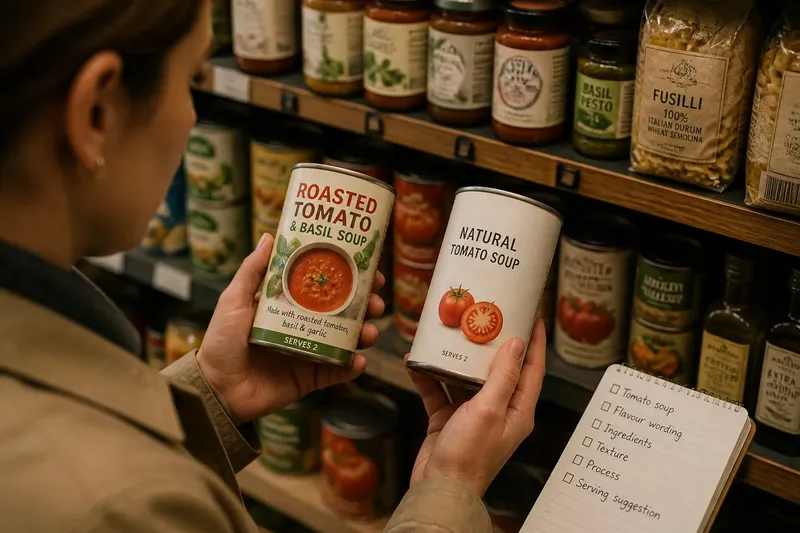
What “No Added Sugar” Actually Says
“No added sugar” describes what went into a food, not its total sugar. Learn how to read the ingredients and nutrition panel together.
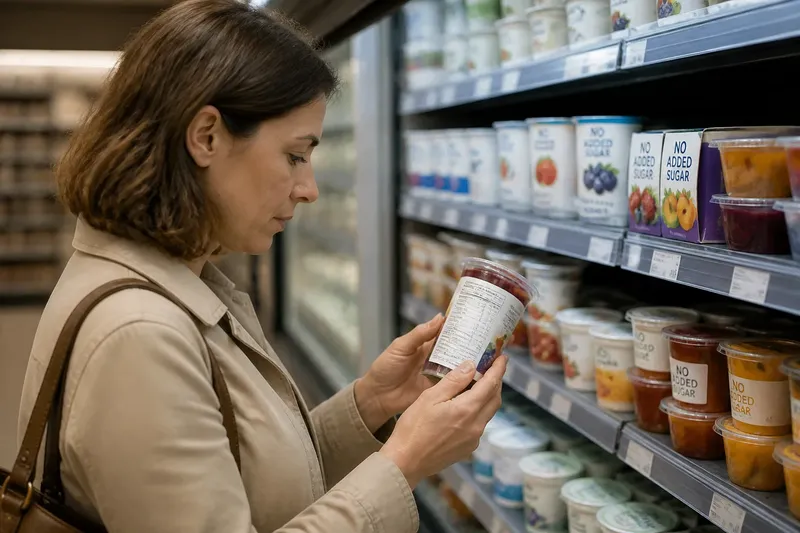
The common mistake with a “no added sugar” label is treating it as a promise that the food contains little or no sugar. It costs readers a clear view of what they are choosing: the claim concerns added ingredients, while sugars naturally present in fruit, milk and other foods can still appear on the nutrition panel.
Read the phrase as one piece of information, then check the ingredient list and the nutrition declaration. These seven points help separate what the label says from what it leaves unanswered.
1. What does “no added sugar” actually mean?
In ordinary label reading, “no added sugar” says that sugars have not been added as an ingredient. It does not say that a product is sugar-free, low in total sugars or lower in sugar than another product.
For example, a food made with fruit may contain sugars that were already present in that fruit. The claim can therefore appear alongside a non-zero figure for “sugars” in the nutrition information. Those two statements are not automatically contradictory: they refer to different things.
Exact claim rules can depend on the product label and local regulations, so treat the wording as a specific claim rather than a full nutritional verdict.
2. Why can total sugars still be listed?
The nutrition panel’s “sugars” line reports sugars in the food, regardless of whether they came from an added ingredient or were naturally present in a component. The ingredients list, by contrast, names what was used to make the product. Comparing the two helps answer separate questions: how much sugar is in the food, and what ingredients contributed to it?
Consider plain yoghurt with fruit. Milk contains lactose, a naturally occurring sugar, and the fruit may contribute more. A “no added sugar” claim would not make either source disappear from the total-sugars figure.
Do not try to subtract an imagined natural-sugar amount from the panel. Unless the label clearly separates the sources, the total figure does not tell you how much came from each ingredient.
3. What should you look for in the ingredients list?
Scan the full list rather than stopping at the claim on the front. An ingredient list can show whether the food includes fruit, milk or another sugar-containing ingredient, as well as revealing sweeteners and other additions that matter to your choice.
Words such as honey, syrup, fruit juice concentrate and sugar name ingredients that can contribute sweetness. Their presence needs to be considered alongside the precise claim and the rules that apply to the product; the wording “no added sugar” should not be used to guess what every ingredient legally counts as.
Also check the order of ingredients. Ingredients are generally listed by weight in descending order, so their position can offer a rough sense of prominence, not a measure of how much sugar each contributes. A fruit ingredient near the top does not reveal its precise sugar content.
4. How do you compare two products fairly?
Start with the same kind of food and compare the nutrition panels on the same basis, such as per 100 g or per 100 ml when that information is provided. A per-serving comparison can mislead if the stated servings differ, or if the amount you would actually eat is unlike the suggested portion.
Then compare the ingredients lists. One product may contain less total sugar but use a different mix of ingredients; another may make the claim while still having sugars from fruit or milk. Decide which question matters for your choice instead of assuming one panel can answer every question.
Imagine you are choosing between two fruit compotes, and both say “no added sugar”. One has a lower total-sugars figure per 100 g, while the other lists more fruit near the top. If your priority is the total sugar in a comparable amount, the nutrition panel is the relevant comparison; if you want to understand the recipe’s composition, the ingredient list adds useful context. Neither detail, by itself, settles every preference.
5. What does the claim not tell you?
It does not describe the food’s overall nutritional quality, how sweet it tastes, or how much sugar you will consume in the portion you serve. It also does not tell you whether the product suits a particular eating plan or medical need. Those questions require other information, and individual health advice should come from a qualified professional.
Nor does “no added sugar” mean that a food contains no sweetening ingredients of any kind. A product might use a non-sugar sweetener, for instance, so check the ingredients if that distinction matters to you. The claim alone is not a complete account of taste or formulation.
6. What should you check before putting the phrase in context?
- Find the total-sugars line. Read the amount shown rather than inferring it from the front label.
- Check the stated basis. Note whether the figure is per 100 g, per 100 ml or per serving.
- Read the ingredients list. Look for fruit, milk, sweeteners and other ingredients relevant to your decision.
- Compare like with like. Set similar foods beside one another and use the same quantity as your basis.
- Consider your usual portion. If the serving on the pack differs from what you eat, make the comparison in a way that reflects your own portion.
- Keep the claim narrow. Treat it as information about added sugar, not a broad claim that the product is low in sugar or nutritionally better.
There is little value in trying to identify the exact contribution of each ingredient from a standard nutrition panel. If the label gives only total sugars, it does not provide the breakdown needed for that calculation.
7. Which label questions help clear up the confusion?
Does “no added sugar” mean sugar-free?
No. Naturally occurring sugars may still be present, and the nutrition panel may list them under total sugars. Check that panel for the amount rather than relying on the front-of-pack wording.
Can fruit make a product contain sugar without sugar being added?
Yes. Fruit has naturally present sugars, which can contribute to a food’s total-sugars figure. The ingredients list can show whether fruit is part of the product, though it may not reveal its exact contribution.
Is “no added sugar” the same as “low sugar”?
No. The first claim concerns added sugar; the second describes a different property of the food and has its own labelling criteria. Look for the relevant nutrition information and do not treat the phrases as interchangeable.
Can a product have no added sugar and still taste sweet?
Yes. Fruit and other ingredients can bring sweetness, and a product may also contain a sweetener. The ingredients list can help explain the formulation, while taste itself is not measured by the claim.
For “no added sugar”, keep the distinction simple: the phrase tells you about added ingredients, and the nutrition panel tells you the food’s total sugars. Read both, compare similar products on the same basis, and let the rest of the label answer questions the claim was never meant to settle.